Sent from my iPad
Begin forwarded message:
From: "Moon, Larry J. (JSC-EA411)" <larry.j.moon@nasa.gov>
Date: January 6, 2015 at 11:37:22 AM CST
To: "Moon, Larry J. (JSC-EA411)" <larry.j.moon@nasa.gov>
Subject: FW: NASA and Human Spaceflight News - Tuesday – Jan. 6, 2015
Well look at who is finally back.NASA and Human Spaceflight NewsTuesday – Jan. 6, 2015HEADLINES AND LEADSSpaceX Rocket Launch Is Called Off Minutes Before LiftoffKenneth Chang – New York TimesThe launch countdown of a rocket carrying equipment and supplies for the International Space Station was called off just minutes before the rocket was to lift off from Cape Canaveral, Fla., on Tuesday morning.SpaceX Falcon 9 rocket launch scrubbed, next attempt FridayGreg Pallone - My News 13 OrlandoA technical issue has scrubbed Tuesday's launch attempt of a SpaceX Falcon 9 rocket.GAO Denies Sierra Nevada Protest of Commercial Crew ContractJeff Foust – Space NewsThe U.S. Government Accountability Office rejected Jan. 5 a protest filed by Sierra Nevada Corp. of commercial crew development contracts NASA awarded in September to two other companies.Sierra Nevada to Continue Dream Chaser Despite CCtCAP Protest LossMarcia S. Smith - Spacepolicyonline.comSierra Nevada Corporation (SNC) said today that it will continue developing and testing its Dream Chaser spacecraft even though it lost its protest of NASA's Commercial Crew Transportation Capability (CCtCAP) awards to Boeing and SpaceX.With Eye on SpaceX, CNES Begins Work on Reusable Rocket StagePeter B. de Selding – Space NewsThe French space agency, CNES, on Jan. 5 said it has begun a small technology research program with Germany and other governments to develop a future liquid oxygen/methane-powered rocket stage that would be reusable.Encouraging private investment in space: does the current space law regime have to be changed? (part 1)Jonathan Babcock – The Space Review
It appears likely that private commercial interests in space will continue to grow in the coming decades. Private actors are increasingly looking to space activities as new frontiers to gain what they believe are near limitless profits. Individuals such as Elon Musk and Richard Branson, along with companies including Planetary Resources and Deep Space Industries, are currently investing in space activities in various forms. Like all investors, these private actors are motivated by profit. Yet, investing in space is both risky and expensive. Moreover, given the current status of international law pertaining to space, little protection for investors exists. Hence, private commercial ventures in space face critical obstacles today that serve to discourage further investment.CATS instrument to launch on CRS-5 and measure particulates in atmosphereRae Botsford – Spaceflight InsiderThe fifth of twelve planned Commercial Resupply Services missions launched by SpaceX, CRS-5, is now scheduled to launch no earlier than Jan. 6 2015. When it takes to the skies, it will carry with it not only necessary supplies for the crew on board the International Space Station (ISS), but also the Cloud-Aerosol Transport System, or CATS. This instrument: "uses a light detection and ranging (LiDAR) system to measure the location, composition and distribution of pollution, dust, smoke, aerosols and other particulates in the atmosphere," according to NASA's website.Alien Oceans May Flow on 'Super-Earth' PlanetsMiriam Kramer - Space.comAlien worlds more massive than Earth could harbor long-lasting oceans, according to new research.Philae comet lander eludes discoveryJonathan Amos – BBC NewsEfforts to find Europe's lost comet lander, Philae, have come up blank.Hubble's Stunning New View of the 'Pillars of Creation'Ian O'Neill - Discovery.comTwenty years ago, the Hubble Space Telescope showed the world what has become one of the most famous images of our time. Staring deep into the Eagle Nebula, Hubble demonstrated its sheer imaging power, picking out the vast pillars of gas and dust in a star-making factory. Deep within their dusty cocoons, baby stars are being born, a factor that spawned the apt moniker "Pillars of Creation."COMPLETE STORIESSpaceX Rocket Launch Is Called Off Minutes Before LiftoffKenneth Chang – New York TimesThe launch countdown of a rocket carrying equipment and supplies for the International Space Station was called off just minutes before the rocket was to lift off from Cape Canaveral, Fla., on Tuesday morning.A launch commentator on NASA Television said the rocket experienced an "actuator drift" issue with the second-stage propulsion system.The rocket — built and operated by Space Exploration Technologies Corporation of Hawthorne, Calif., or SpaceX — is packed with a payload of more than 5,000 pounds.In addition, SpaceX plans to try an experimental, daring maneuver to land the first stage of the rocket on a floating platform in the Atlantic. The company hopes that the step will lead to reusable rockets, which would greatly cut the cost of space travel.The next launch opportunity is on Friday at 5:09 a.m. Eastern time. The forecast calls for an 80 percent chance of favorable weather.SpaceX Falcon 9 rocket launch scrubbed, next attempt FridayGreg Pallone - My News 13 OrlandoA technical issue has scrubbed Tuesday's launch attempt of a SpaceX Falcon 9 rocket.The SpaceX Falcon 9 rocket was set to soar at 6:20 a.m. from Cape Canaveral Air Force Station with supplies for the International Space Station.The countdown was halted with just one minute remaining due to an issue with the secondary rocket system.The launch has been rescheduled for 5:09 a.m. Friday.
The Dragon capsule aboard the rocket contains more than 5,000 pounds of supplies and experiments ordered up by NASA. That's the primary objective for SpaceX.This is the sixth trip by a Dragon spacecraft to the ISS.NASA says the Dragon spacecraft will remain attached to the space station's Harmony module for more than four weeks and then splash down in the Pacific Ocean, off the coast of Baja California, bringing with it almost two tons of experiment samples and equipment from the station.SpaceX is also trying to make history during this mission. The company trying to land its Falcon 9 rocket on a barge off the coast of Jacksonville.The barge is now stationed in its designated spot. It arrived Monday afternoon. The goal is to cut down costs by reusing these boosters, which historically would land and sink in the ocean.SpaceX CEO Elon Musk has said he gives a 50-50 shot at landing the booster this first time.The first stage of the Falcon 9 rocket is expected to land on the barge within 10 minutes of liftoff. The second stage will continue to propel the Dragon capsule to orbit.GAO Denies Sierra Nevada Protest of Commercial Crew ContractJeff Foust – Space NewsThe U.S. Government Accountability Office rejected Jan. 5 a protest filed by Sierra Nevada Corp. of commercial crew development contracts NASA awarded in September to two other companies.In a statement, Ralph O. White, managing associate general counsel for procurement law at GAO, said that the agency had rejected claims by Sierra Nevada regarding the Sept. 16 award of Commercial Crew Transportation Capability (CCtCap) contracts to Boeing and Space Exploration Technologies Corp.Sierra Nevada filed its protest Sept. 26, asserting that its proposal had technical merits similar to the winning companies but at a lower cost than at least one of them. In a statement issued the same day as the protest, the company claimed there were "serious questions and inconsistencies in the source selection process." The deadline for the GAO to rule on the protest was Jan. 5.The GAO, in its statement, said Sierra Nevada argued that NASA had improperly deviated from the CCtCap selection criteria by "significantly elevating" the goal of having a crew system certified to carry astronauts by the end of 2017, and not communicating that goal to the bidding companies."GAO disagreed with Sierra Nevada's arguments about NASA's evaluation, and found no undue emphasis on NASA's consideration of each offeror's proposed schedule, and likelihood to achieve crew transportation system certification not later than 2017," White said in the statement. He added that the GAO found that NASA's request for proposals for CCtCap made clear the 2017 goal of certification.The GAO said Sierra Nevada's protest also made several other claims, including that NASA made an "inadequate review" of SpaceX's price and financial resources, a "flawed and disparate evaluation" of each proposal's mission suitability factor, a major element of the selection process, and an improper review of the past performance element of the proposals."Based on our review of the issues, we concluded that these arguments were not supported by the evaluation record or by the terms of the solicitation," Smith said in the GAO statement.Sierra Nevada, in a statement issued Jan. 5, accepted the decision by the GAO and said it would continue to find alternative avenues to support development of the Dream Chaser vehicle it proposed to NASA."While the outcome was not what [Sierra Nevada Corp.] expected, we maintain our belief that the Dream Chaser spacecraft is technically very capable, reliable and was qualified to win based on NASA's high ratings of the space system," the company said in its statement.Sierra Nevada spokesperson Krystal Scordo said that the company would continue working on the final milestone of an earlier NASA commercial crew award, involving a second glide flight of a Dream Chaser engineering test vehicle. That test is planned for 2015, but she said the company has not set a more specific date.NASA welcomed the denial of the protest. "The GAO's decision allows the agency to move forward and continue working with Boeing and SpaceX" on the CCtCap contracts, the agency said in a Jan. 5 statement.The GAO, while announcing the rejection of the protest, said it would not yet release the formal decision because it contained sensitive information. A redacted version of the decision statement should be publicly available within a few weeks, it said. NASA also said it would not release further details until the GAO decision is published.The GAO statement did, though, contain new information about the CCtCap bids. It said that Sierra Nevada offered a price of $2.55 billion to develop its Dream Chaser vehicle. That made the company more expensive than SpaceX, which bid $1.75 billion, but less expensive than Boeing's bid of $3.01 billion.When NASA announced the CCtCap awards in September, it valued Boeing's contract at $4.2 billion and SpaceX's contract at $2.6 billion. Those contract values include six flights for each company, although the companies are guaranteed only two each.Sierra Nevada to Continue Dream Chaser Despite CCtCAP Protest LossMarcia S. Smith - Spacepolicyonline.comSierra Nevada Corporation (SNC) said today that it will continue developing and testing its Dream Chaser spacecraft even though it lost its protest of NASA's Commercial Crew Transportation Capability (CCtCAP) awards to Boeing and SpaceX.The Government Accountability Office (GAO) ruled in NASA's favor today, denying SNC's protest that NASA did not evaluate its bid in accordance with the criteria specified in the request for proposals. The company said GAO's decision was "not what SNC expected" and is "evaluating" that decision.GAO did not release the details of its decision, only a summary in a press release. The complete text of the decision is under protective order and must be redacted before being made public.NASA has been supporting all three companies in the Commercial Crew Integrated Capability (CCiCAP) phase of the commercial crew program, a public-private partnership whose goal is to develop U.S. crew space transportation systems to take astronauts to and from the International Space Station (ISS). NASA has been dependent on Russia to provide crew transportation services since the space shuttle was terminated in 2011 and is eager to restore an independent capability through this program.NASA was expected to choose only two of the three to continue into the CCtCAP phase. Price was listed as the top criterion and SNC's price was much lower than Boeing's. According to GAO's summary, Boeing's price was $3.01 billion, SNC's was $2.55 billion, and SpaceX's was $1.75 billion. NASA awarded more than that to Boeing and SpaceX. Boeing received $4.2 billion and SpaceX received $2.6 billion. NASA explains that its award is the Total Potential Contract Value, which includes special studies and the maximum number of post-certification missions -- six. GAO's figures are for the Evaluated Price as defined in the CCtCAP request for proposals, which has a guarantee of only two missions.SNC said today that "we maintain our belief that the Dream Chaser spacecraft is technically very capable, reliable and was qualified to win based on NASA's high ratings of the space system." Dream Chaser is a lifting body -- a winged vehicle -- that resembles a space shuttle orbiter and would be launched on an Atlas V rocket. It is based on a design NASA developed decades ago for the HL-20 program.At the International Astronautical Congress (IAC) in Toronto shortly after SNC challenged NASA's choice of Boeing and SpaceX in September, SNC made clear that it intended to proceed with Dream Chaser regardless of whether it won the protest or not. Today's announcement was in a similar vein. "SNC firmly believes that the Dream Chaser will play a central role in shaping the future of space transportation with its unique capabilities which address a wide spectrum of needs," it said, adding that it responded to NASA's request for proposals for a second round of commercial cargo resupply services awards. SpaceX and Orbital Sciences Corporation currently provide commercial cargo services to NASA under contracts that expire in 2016.NASA also issued a statement in response to the GAO ruling, saying simply that it is pleased it can move forward with the commercial crew program so America can end its reliance on Russia for ISS crew transportation.With Eye on SpaceX, CNES Begins Work on Reusable Rocket StagePeter B. de Selding – Space NewsThe French space agency, CNES, on Jan. 5 said it has begun a small technology research program with Germany and other governments to develop a future liquid oxygen/methane-powered rocket stage that would be reusable.Speaking the day before U.S. rocket maker SpaceX was scheduled to attempt to recover the first stage of its Falcon 9 rocket following the launch of a cargo freighter to the international space station, CNES officials said they have not abandoned reusability a decade after starting a joint project with Russia. The SpaceX launch has since been postponed to no earlier than Jan. 9.That project, called Baikal, has since been shelved as CNES officials concluded that a rocket system with a reusable first stage would need to launch some 40 times a year to make the effort worthwhile.Michel Eymard, CNES's director of launchers, said European Space Agency governments in December approved a modest research effort to refine technologies eventually needed to recover, refurbish and reuse an entire Ariane rocket stage.Reusability is not among the features of Europe's future Ariane 6 rocket, which is scheduled to make an inaugural flight in 2020. Led by CNES and France, which agreed to finance a 52 percent stake in the project, ESA governments are investing more than 4 billion euros ($5 billion) in the Ariane 6.CNES worked with various Russian state organizations a decade ago looking for reusable technologies that could be applied to both European and Russian rockets. But Eymard said little came of the effort because of the difficult economics of refurbishing a used rocket stage.Hawthorne, California-based Space Exploration Technologies Corp. was the principal catalyst for the Ariane 6 program following SpaceX's first Falcon 9 launch successes and its ability to sell rides aboard that rocket at much less cost than Europe's current Ariane 5.Eymard said he had little doubt that SpaceX will be able to recover a Falcon 9 first stage and return it to the factory. The problem is the duration and cost of the refurbishment, he said, and the need to reach a launch rhythm that justifies the work."What you have to be able to tell your customers is that the fourth or fifth time you are using the stage will provide the same performance and reliability as its first use," he said.Eymard was asked whether CNES is not in the position of having spent two years to catch up to SpaceX with a lower-cost expendable rocket in Ariane 6, only to find that SpaceX has moved to a partially reusable model that cuts costs even further."We don't want to be in the position of appearing to follow in their footsteps all the time," Eymard said. "But we admire what they are doing and we think it helps put pressure on all of us to do better."ESA's reusable-launcher program is small in size, although when matched with work done by CNES on its own and by the German Aerospace Center, it could produce a consensus on a future technology roadmap by mid-2015. But a vehicle demonstration of the sort SpaceX has planned, he said, will not occur before 2026.CNES officials have said that in addition to the need for a high launch rhythm, a rocket with a reusable first stage would need to overcome the fact that reusability means reducing the economies of scale realized from producing lots of rocket stages and motors.The Ariane 6 is designed to carry two telecommunications satellites weighing a combined 9,500 kilograms into geostationary transfer orbit. The vehicle's cost objective is about 90 million euros ($113 million), or 45 million euros per satellite customer — not far from the current SpaceX price.CNES President Jean-Yves Le Gall, addressing a briefing here Jan. 5 on CNES's 2015 plans, said Ariane 6 should be able to be sold commercially at its production cost, which would be substantially better than today's Ariane 5."Today the Ariane 5 is sold for about 150 million euros, but it costs about 170 million euros per launch," Le Gall said. "European governments make up the difference. These government payments will not be needed for Ariane 6."Eymard said the Ariane 6 design, being managed by Airbus Defence and Space and Safran in a newly created joint venture, is already able to launch 10,900 kilograms of payload to geostationary transfer orbit, with enough leftover performance to deorbit its upper stage — a requirement of France's new Space Law.Encouraging private investment in space: does the current space law regime have to be changed? (part 1)Jonathan Babcock – The Space Review
It appears likely that private commercial interests in space will continue to grow in the coming decades. Private actors are increasingly looking to space activities as new frontiers to gain what they believe are near limitless profits. Individuals such as Elon Musk and Richard Branson, along with companies including Planetary Resources and Deep Space Industries, are currently investing in space activities in various forms. Like all investors, these private actors are motivated by profit. Yet, investing in space is both risky and expensive. Moreover, given the current status of international law pertaining to space, little protection for investors exists. Hence, private commercial ventures in space face critical obstacles today that serve to discourage further investment.This article will analyze the problems facing private actors in space, and will offer a practical solution to overcome them. First, it will describe the obstacles that private actors face in undertaking commercial space ventures. It will then analyze the current legal regime governing space activities, such as the 1967 Outer Space Treaty and 1979 Moon Treaty. Finally, the article will examine various proposals for making international space law more amenable to private investment. This comparison will show that we don't need a wholesale replacement of the Outer Space Treaty with a new legal regime. Instead, a solution realizing limited property rights within the existing legal structure provided by the Outer Space Treaty best serves to encourage future private investment while still upholding the necessary prohibition on national claims of sovereignty in space.Private commercial actors in spaceRegardless of the field, private actors are chiefly motivated by profits. Exploration and innovation are not done solely in an altruistic manner to benefit society (although that is sometimes the case), but rather as a means to secure profits.1 This is true of private commercial actors in space, where both individuals and companies are already undertaking, or plan to undertake in the near future, commercial ventures that have come to be labeled under the umbrella category of private space exploration.2 This refers to a diverse set of activities undertaken by private actors in space such as space mining, launch services (highlighted by Elon Musk's space transportation company, SpaceX), and space entertainment (mostly in space tourism such as Richard Branson's Virgin Galactic).3 Branson and Musk are not alone in viewing space as the next untapped market to be exploited for massive profits. Other individuals such as Paul Allen, Jeff Bezos, James Cameron, Robert Bigelow, and John Carmack are engaged in investing in space, albeit in varying degrees.4 These "astropreneurs," as they are sometimes called, share common traits that cause them to be interested in investing in space.5 After all, commercial investments in space are not the simplest way to earn a profit. So what is it that makes these individuals interested in space on a personal level? Outside of having incredible personal wealth that allows them the luxury of expendable income, these individuals share a fascination with space and possess the know-how to navigate the complex world of high-tech industries.6 They are motivated by these personal interests and skills to turn their commercial investments in space into profitable ventures.In addition to these individuals, companies such as Planetary Resources, Deep Space Industries, and Moon Express and have shown interest in undertaking ambitious commercial projects in space in the upcoming decades.7 These companies highlight the potential of space to not only provide massive profits but to also hold the keys to solving societal problems here on Earth, such as energy and natural resources.8 However, these interests are currently primarily in space mining, an industry that has yet to become technologically feasible in a sense that would make it economically viable, but potentially could offer immense profits. US companies such as Deep Space Industries and Planetary Resources have announced plans to begin mining asteroids by 2020 to 2025.9What is it that causes such optimism in space mining? Namely, these companies argue that space is teeming with valuable resources.10 In near Earth asteroids alone (which are the most feasible in terms of near-future technological advances), there may potentially be vast amounts of iron, nickel, cobalt, magnesium, and gold, along with reserves of water and its constituents, hydrogen, and oxygen.11 Platinum, another valuable metal on Earth, is also believed to be available to mine in space albeit further in the future.12 If successful, the entire cost of establishing the mining operation could be paid off with the delivery of only a couple tons of these respective materials back to Earth.13 Yet, despite the potential for vast profits, private actors have been more reluctant than one would imagine in undertaking such ventures in space.Several reasons exist for their hesitation. For one, technology is not yet at the point where these ventures are clearly feasible. Given the cost of reaching the desired destinations in space, coupled with the limitations of modern technology, it is premature for these companies and individuals to believe they will see profits from space mining in the near future.14 However, a more philosophical problem exists that many private actors identify as one of the main impediments to further private commercialization of space. This problem involves the scope of private property rights in space: whether they exist at all, and if they do, what is their applicability to resource extraction.15Space law, derived mainly from the Outer Space Treaty and the Moon Treaty (the latter's principles carry weight despite having a few signatory states), prohibits national appropriation in space and states that space is a domain for the "common heritage of mankind." The meaning of these documents, particularly pertaining to their applicability to private actors in space, is ambiguous and contentious, as will be shown in the following section. In any industry, legal uncertainty hinders private investment. Accordingly, a cloudy legal regime in space has hampered the ability of private individuals and firms to raise the capital necessary to fund space activities.16 Moreover, private actors hold that the absence of a legal regime clearly defining the scope of property rights in space deprives them of the assurance that they will reap benefits that will outweigh the capital they invested.17 They argue that the main impediment to further private action in space is that the current legal regime jeopardizes the ability of private actors to make a profit in space.This is a discouraging climate for private innovation, and will surely discourage future investment in space. The legal regime governing space must be clarified, added to, altered, or changed entirely to encourage private investment in space by allowing actors to realize financial rewards.18 The question then becomes how to accomplish this. In order to better understand the inadequacies of the current legal regime, it is necessary to analyze what exactly the Outer Space Treaty and Moon Treaty state, and how they dictate the climate in which private actors are operating in space.The legal regime in spaceModern space law emerged mostly in the 1960s and 1970s, in the midst of the Cold War, and has seen little revision since. This backdrop made sure that the legal regime addressed concerns over claims to national sovereignty in space by prohibiting national appropriation, and aimed at preventing tensions between the United States and the Soviet Union being brought to space.19 There are four principal reasons why both the US and Soviet Union sought to create a legal regime prohibiting sovereign claims and encompassing Cold War concerns:
- they wanted to prevent an expansion of conflict to outer space;
- they sought to preserve the doctrine of free access to space;
- they knew that delineating boundaries in space would cause tension, and;
- they wanted to enhance their prestige vis-à-vis Third World states who would be pleased with a prohibition on sovereign claims in space.20
These were valid concerns at the time, and were codified in five principal treaties that, together, account for the current international space law regime. A concern offered by many private actors in space, however, is that the doctrines in these treaties, influenced by the Cold War, are outdated and need to be altered to better reflect the current climate of increasing private commercial interest in space.The most important of these five treaties is the 1967 Outer Space Treaty. Four other international treaties from the Cold War era of the 1960s and 1970s complement the Outer Space Treaty: the Agreement on the Rescue of Astronauts, the Return of Astronauts, and the Return on Objects Landed in Outer Space ("Rescue Agreement"); the Convention on International Liability for Damage Caused by Space Objects ("Liability Convention"); the Convention on Registration of Objects Launched into Outer Space ("Registration Convention"); and the Agreement Governing the Activities of States on the Moon and Other Celestial Bodies ("Moon Agreement").21 For the purposes of this essay, the Outer Space Treaty and the Moon Agreement are of paramount importance. Together, these two treaties comprise the foundation of international space law, and are sometimes called the "Magna Carta of space."22 The other three treaties are not entirely relevant to the present discussion. The cores of both the Outer Space and Moon Treaties will now be explained in turn.The Outer Space Treaty, which forms the basis of law governing activities in outer space, was signed and ratified in 1967. An important element of the treaty is the fact that it is a statement of principles governing the desirable actions of parties in space, rather than rules clearly delineating substantive law.23 Although the language is often vague by legal standards (as the debate over the meaning of Article II will show), the treaty expects to set a pattern for behavior instead of a list of regulations.24 Essentially what the Outer Space Treaty accomplished was to take previously agreed upon United Nations principles on space activities and give them a legally binding form. Therefore, the Outer Space Treaty is sometimes referred to as the first "Space Charter."25Permeating the entire document is the notion that space is for the "common interest of mankind."26 This was done in an attempt to address both the Cold War concerns of sovereign claims in space, and to ease the worries of developing states that space activities would only be done by wealthy, developed states at the expense of poorer ones. Article I of the treaty notes as much by stating that activities in outer space "shall be carried out for the benefit and in the interests of all countries, irrespective of their degree of economic or scientific development, and shall be the province of all mankind."27 Given this notion of free access to space for all nations, the prohibition on national appropriation in space under Article II is not surprising. Article II states, "Outer space, including the Moon and other celestial bodies, is not subject to national appropriation by claim of sovereignty, by means of use or occupation, or by any other means."28 There is little doubt that Article II is of critical legal significance in terms of governing activities in outer space, but there has been debate over what exactly it means.Most of the tension has centered on differing interpretations of "national appropriation." Some lawyers interpret the article in a narrow sense, using a text-based approach. In this sense, Article II only explicitly prohibits "national" appropriation.29 Others argue that Article II should be interpreted more broadly to prohibit all types of appropriation, both national and private.30 Private actors who argue that they have no legal grounds with which to claim property in space are articulating the broader interpretation of Article II. They argue that this prohibition on all appropriation hinders their ability to reap financial rewards from exploits in space.However, when looked at more closely and in conjunction with the Moon Agreement, it will be shown that this broad interpretation is incorrect. The current legal regime in space does indeed allow for limited claims to property rights in space, drawing on Article XIII of the Outer Space Treaty. Therefore, there is a way in which the interests of private commercial actors in space could be safeguarded to encourage future investment within the existing legal regime. After all, terminology is not the deciding factor. Investors do not care if they enjoy full property rights or real limited property rights. They care about the bottom line: will a legal provision help them gain profits? If the answer is yes, then such a provision would solve the current problem of ambiguity in the existing legal regime and encourage increased private investment in space in the future.In order to fully address the justification for using the strict interpretation of Article II rather than the broader one, it is necessary to understand how the Moon Agreement works in conjunction with the Outer Space Treaty. The Moon Agreement for the most part echoes the sentiments established in the Outer Space Treaty. It is more extreme in some respects, however. At the time it was drafted, it sought to address the status of property rights in space left open by the Outer Space Treaty.31 For example, as the Outer Space Treaty recognized a "common interest" in space shared by all countries, the Moon Agreement went further by asserting that space is the "common heritage of mankind."32 While the idea of space as a "common interest" certainly existed in the Outer Space Treaty and in previous UN discussions on space activities, the notion of space being "the common heritage of mankind," a further step in precluding any type of ownership in space, first appeared in the Moon Agreement.33Drawing on this underlying idea, the Moon Agreement then states its most novel point in Article XI: that "neither the surface nor the subsurface of the Moon… shall become property of any state, international inter-governmental or non-governmental organization, national organization or non-governmental entity or natural person."34 References to the "Moon" in the Moon Agreement are understood to refer to all celestial bodies.35 This non-appropriation clause is more inclusive than Article II in the Outer Space Treaty, and its language further expanding the explicit prohibition on property rights in space was very contentious at the time the treaty opened for signature in 1979, and remains to this day.36The contentious nature of the contents of the Moon Agreement has, for all intents and purposes, limited its impact on international space law because it has very few signatory states. It is essentially a failed piece of international law because as of August 2014, only 16 states had signed it.37 Moreover, none of the major spacefaring nations has become a party to the treaty.38 The main point of contention precluding these states from acceding to the Moon Agreement is that it is too extreme in limiting the scope of commercial actions allowed in space, both national and private. For example, US private space industry viewed Article XI as essentially an all-encompassing moratorium on commercial space activities (much more so than the Outer Space Treaty, to which they also have great concerns.)39Despite not having many parties to the treaty, the principles within the Moon Agreement carry weight when states think about actions in space. Therefore, taken together, Article II of the Outer Space Treaty, and, to a lesser extent, Article XI of the Moon Agreement, constitute the elements of the current space law regime that private commercial actors in space believe are hostile to their investments. Upon closer examination, however, this accusation does not hold up. The current legal regime in space, dominated by the two preceding agreements, does indeed allow for a limited form of property rights in space, when one takes a more nuanced look at the contents of these treaties.It is misguided to use the broad interpretation and state that the Outer Space Treaty prohibits all types of appropriation under Article II. Part of the prohibition on national appropriation in Article II is based on sovereign claims made by states in space. So at first glance, it would appear that current space law prohibits all sovereign claims in space. But this is not the entire picture. In fact, the Outer Space Treaty allows, and in some cases requires, that states have control over space facilities while not claiming them as part of their country.40 The most prominent example of such a provision is Article VIII, which requires parties to "retain jurisdiction and control over… space objects on their registry… and over any personnel thereof, while in outer space or on a celestial body."41 This amounts to "quasi-territorial" jurisdiction being conferred by the Outer Space Treaty to state actors in space based on functional sovereignty rather than territorial sovereignty. This is different from sovereignty in the full sense of the word (absolute and based on territorial claims), which is still outlawed under Article II, but allows the state to have "ownership" of the space facility in a legal sense for a limited functional purpose. This jurisdiction applies to the space facility, a reasonable area around the facility, and all of the personnel in or near the facility irrespective of nationality.42 Article VIII jurisdiction permits the controlling state to subject any personnel in the facility to its national laws as long as they do not clash with international obligations. Thus, Article VIII allows for a limited version of property rights in space, in which a state can use a facility for its own purposes without having to make sovereign claims on it, providing evidence that Article II of the Outer Space Treaty is not a blanket prohibition on all forms of appropriation in space.Moreover, two other less significant points give credence to the idea that no complete prohibition on private appropriation in space exists. First, Article VI of the Outer Space Treaty leaves open the possibility of private and "national" activities in space, but requires that they be supervised by a state that is responsible for their actions.43 So it seems as if private actors can undertake operations in space and appropriate for all intents and purposes so long as a state takes responsibility for their actions.Second, the very existence of the Moon Agreement leads one to question whether Article II prohibits all appropriation. If the Outer Space Treaty outlawed all types of appropriation in space under a blanket Article II prohibition, would it be necessary for a subsequent treaty to outlaw appropriation of the Moon and celestial bodies?44 The answer to that question seems to clearly be no. Taken together, these provisions show that the Outer Space Treaty does prohibit national appropriation in space, but leaves open the possibility of private appropriation. There is no denying that this possibility is ambiguous, however, and this ambiguity will serve as a reason for why the current system should be clarified or altered, but not replaced, to further encourage private investment in space.Like the Outer Space Treaty, the Moon Agreement also contains provisions under which appropriation in space is allowed, thus proving that industry fears of a legal regime that outlaws all appropriation in space is misguided. As stated before, the Moon Agreement holds that space and space resources are the "common heritage of mankind." But if that is true, could not "mankind" decide to appropriate space for its own benefit? What would constitute "mankind" in that scenario? One could envision a system in which an international organization works by international consensus to authorize appropriation in space of the Moon or other celestial bodies.45 Therefore, it can be argued that the Moon Agreement establishes a prohibition on appropriation of the Moon and celestial bodies, but leaves open the opportunity to work around this prohibition based on an authorizing regime governed by international consensus. In other words, the Moon Agreement permits the exploitation of celestial bodies provided that an international regime is established to govern the process.46 So while the common rhetoric is that the current space law regime outlaws appropriation in space and thus discourages investment, this narrative does not paint a true picture. The two treaties simply outlaw unilateral appropriation.47 Therefore, these treaties allow for provisions to be taken to clarify the existing regime to make it more attractive to investors.Endnotes
- Lawrence Risley, " Examination of the Need to Amend Space Law to Protect the Private Explorer in Outer Space," Western State University Law Review (1999), p. 47.
- Ozgur Gortuna, Fundamentals of Space Business and Economics, (Springer: 2013), p. 56.
- Ibid.
- Ibid.
- Ibid., p. 57.
- Ibid.
- Laura, Delgado-Lopez, "Beyond the Moon Agreement: Norms of Responsible Behavior for Private Sector Activities on the Moon and Celestial Bodies," Space Policy (2014), p. 2.
- Zach Meyer, "Private Commercialization of Space in an International Regime: A Proposal for a Space District," Northwestern Journal of International Law and Business (Winter 2010), p. 6.
- Fabio Tronchetti, "Private Property Rights on Asteroid Resources: Assessing the Legality of the Asteroids Act," Space Policy (2014) p. 2.
- Rand Simberg, "Property Rights in Space," The New Atlantis (Fall 2012), p. 1.
- Tronchetti, "Private Property Rights on Asteroid Resources," p. 1.
- Simberg, "Property Rights in Space," p.1
- Eva-Jane Lark and Dale S. Boucher, "Space Mining: ISRU as a Driver for a New Economic Space Exploration Model," Presented at Global Space Exploration Conference 2012, p. 1.
- Henry R. Hertzfeld and Frans von der Dunk, "Bringing Space Law into the Commercial World: Property Rights Without Sovereignty," Chicago Journal of International Law (Summer 2005) p. 86.
- Ibid.
- Simberg, "Property Rights in Space," p.1
- Hertzfeld and von der Dunk, "Bringing Space into the Commercial World," p. 81.
- Risley, "Examination of the Need to Amend Space Law," p. 48.
- Ibid., p. 57.
- Wayne N. White, "Implications of a Proposal for Real Property Rights in Outer Space," Proceedings, 42nd Colloquium on the Law of Outer Space (2000), p. 366.
- Meyer, "Private Commercialization of Space in an International Regime," p. 248.
- Ashley A. Hutcheson, "Dollars and Sense: Why the International Space Station is a Better Investment than Deep Space Exploration for NASA in a Post-Columbia World," Journal of Law, Technology, and Policy (2004) p. 3.
- Jeffrey Prevost, "Law of Outer Space Summarized," Cleveland State Law Review Vol. 19 (1970) p. 606.
- Ibid.
- Ibid.
- Meyer, "Private Commercialization of Space in an International Regime," p. 250.
- Treaty on Principles Governing the Activities of States in the Exploration and Use of Outer Space, Including the Moon and Other Celestial Bodies, Jan. 27, 1967, U.N.T.S. 205 [hereinafter Outer Space Treaty], Art. I.
- Ibid., Art. II.
- Wayne N. White, "Real Property Rights in Outer Space," Proceedings 40th Colloquium on the Law of Outer Space (1998) p. 370.
- Ibid.
- Glenn Harlan Reynolds, "The Moon Treaty: Prospects for the Future," Space Policy (1995) p. 3.
- Meyer, "Private Commercialization of Space in an International Regime," p. 251.
- Antonella Bini, "The Moon Agreement: Its Effectiveness in the 21st Century," ESPI Perspectives (2008) p. 4.
- Agreement Governing the Activities of States on the Moon and Other Celestial Bodies, Dec. 5, 1979, G.A. Res. 34 68, (1979) [hereinafter Moon Treaty], Art. XI.
- White, "Real Property Rights in Outer Space," p. 370.
- Delgado-Lopez, "Beyond the Moon Agreement," p. 2.
- Simberg, "Property Rights in Space," p.2.
- Meyer, "Private Commercialization of Space in an International Regime," p. 250.
- Delgado-Lopez, "Beyond the Moon Agreement," p. 2.
- Risley, "Examination of the Need to Amend Space Law," p. 53.
- White, "Real Property Rights in Outer Space," p. 370.
- White, "Implications of a Proposal for Real Property Rights in Outer Space," p. 366.
- Simberg, "Property Rights in Space," p.2.
- Ibid., p. 3.
- Meyer, "Private Commercialization of Space in an International Regime," p. 251.
- Ibid., p. 255.
- Ibid., p. 253.
Jonathan Babcock is currently a senior at The George Washington University's Elliott School of International Affairs in Washington, DC, where he is an International Affairs major with a concentration in International Politics. He spent his junior academic year at The London School of Economics and Political Science, studying International Relations and Law. He will be attending law school after graduation, and is particularly interested in international law.CATS instrument to launch on CRS-5 and measure particulates in atmosphereRae Botsford – Spaceflight InsiderThe fifth of twelve planned Commercial Resupply Services missions launched by SpaceX, CRS-5, is now scheduled to launch no earlier than Jan. 6 2015. When it takes to the skies, it will carry with it not only necessary supplies for the crew on board the International Space Station (ISS), but also the Cloud-Aerosol Transport System, or CATS. This instrument: "uses a light detection and ranging (LiDAR) system to measure the location, composition and distribution of pollution, dust, smoke, aerosols and other particulates in the atmosphere," according to NASA's website.CATS is not a free-floating satellite, but instead it will be mounted to the exterior of the Japanese Experiment Module, which is called Kibo, meaning "hope" in Japanese. This will be done in partnership with the Japan Aerospace Exploration Agency (JAXA). If it does well, it can be scaled up to be a traditional satellite payload.CATS has the ability to provide range-resolved measurements, which means it can distinguish between targets that are close together in bearing but at different ranges (essentially, different distances) from the instrument. It uses a laser with a high repetition rate that operates at three wavelengths: 1064, 532, and 355 nanometers (nm).The 1064- and 532-nm wavelengths are already used by NASA's Cloud-Aerosol Lidar and Infrared Pathfinder Satellite Observations (CALIPSO) mission. However, the addition of the 355-nm wavelength adds the opportunity for observing in greater detail, making it easier to tell different types of particles apart. The instrument also has highly sensitive detectors that can count even individual photons."You get better data quality because you make fewer assumptions, and you get, presumably, a more accurate determination of what kind of particles you're seeing in the atmosphere," said research scientist Matt McGill and principle investigator for CATS at NASA's Goddard Space Flight Center in Maryland.There is some concern that this third laser is prone to being contaminated."If you get contamination on any of your outgoing optics, they can self-destruct, and then your system's dead," McGill said. "You end up with very limited instrument lifetime."Thus, part of the mission is also dealing with that risk, and seeing how the instrument fares in space. Mounting it to the ISS is a way to cut costs in this process.As for the laser's high rate of repetition, CATS can again be compared with CALIPSO, which fires 20 laser pulses per second, each at 110 milliJoules of energy. Conversely, CATS will fire 5,000 pulses every second, though each at about 1 milliJoule. Universe Today has noted that once CATS is mounted to the ISS and when the station passes through Earth's shadow, it may be possible to spot the instrument from Earth despite the relatively low-energy pulses it will be emitting.With its capabilities, CATS will be able to measure details of the cloud and aerosol layers like "layer height, layer thickness, optical depth, extinction, and depolarization-based discrimination of particle type," according to NASA. Further, the agency's website states that "the impact of clouds and aerosols (e.g., pollution, dust, smoke) on a global scale with regards to energy balance and climate feedback mechanisms is not yet fully understood. A better understanding of cloud and aerosol coverage and properties is critical for understanding of the Earth system and its associated climate feedback processes."The usefulness of CATS and similar instruments is partly illustrated by the 2010 eruption of the Eyjafjallajökull volcano in Iceland and the many grounded aircraft and stranded travelers affected by it. The particles in the ash cloud had the potential to seriously damage the engines of aircraft in flight. Now, however, NASA will be able to better track such particles from space as they spread through the air below.The ISS has a helpful orbit for this sort of experiment as it already "passes over and along many of the primary aerosol transport paths within the atmosphere" and "permits study of diurnal (day to night) changes due to the effects of aerosols and clouds in the atmosphere – something other Earth Science satellite cannot readily obtain given their orbits," NASA stated.The current version of the mission is expected to last six months at the bare minimum, and three years maximum. It is one of five Earth science missions that NASA scheduled to launch in 2014 and, along with SMAP, one of two now scheduled for Jan. of 2015 instead.Want to learn more about this promising Earth science mission? Be sure to check out the video below released by NASA Goddard and the CATS team.To view video, visit CATS instrument to launch on CRS-5 and measure particulates in the atmosphereAlien Oceans May Flow on 'Super-Earth' PlanetsMiriam Kramer - Space.comAlien worlds more massive than Earth could harbor long-lasting oceans, according to new research.Scientists have used computer modeling to show that so-called "super-Earth" planets — worlds that are up to five times more massive than Earth — can play host to long-lived oceans. The modeling shows that the oceans can potentially remain on the planet for billions of years, possibly allowing life to develop on the alien planet. Researchers presented the new super-Earth findings during a news conference at the 225th meeting of the American Astronomical Society here in Seattle."When people consider whether a planet is in the habitable zone, they think about its distance from the star and its temperature," lead author of the super-Earth study Laura Schaefer of the Harvard-Smithsonian Center for Astrophysics (CfA) in Cambridge, Massachusetts said in a statement. "However, they should also think about oceans, and look at super-Earths to find a good sailing or surfing destination." [10 Exoplanets That Could Host Alien Life]Scientists think that Earth's oceans have existed for almost the entire history of the planet, and water is key to life as humanity understands it. Therefore, finding other worlds with long-lived oceans could help scientists narrow down planets that might have a good chance of hosting life.Earth's oceans are recycled. Water from the planet's oceans is pulled into the mantle from the crust due to geological activity, but water is also released from the mantle and back into the surface oceans through volcanic activity. The new computer model produced by Schaefer and her team was designed to test if this water recycling can occur on super-Earths with plate tectonics as well, according to the CfA.In fact, some planets larger than Earth could be even better at maintaining oceans than this planet. Schaefer's model shows that a planet two to four times the mass of Earth could host oceans continuously for 10 billion years. The largest planet in the study, which was about five times more massive than Earth, didn't develop an ocean in the computer model for about 1 billion years, but those planets' oceans, once formed, continue to persist on the surface for a long amount of time. .Schaefer and her team suggest that it might be better to hunt for life on older super-Earths. Researchers might have a better chance of finding complex life on planets that are 1 billion years older than Earth, the team said."It takes time to develop the chemical processes for life on a global scale, and time for life to change a planet's atmosphere," the CfA's Dimitar Sasselov, a co-author on the study, said in a statement. "So, it takes time for life to become detectable."Philae comet lander eludes discoveryJonathan Amos – BBC NewsEfforts to find Europe's lost comet lander, Philae, have come up blank.The most recent imaging search by the overflying Rosetta "mothership" can find no trace of the probe.Philae touched down on 67P/Churyumov-Gerasimenko on 12 November, returning a swathe of data before going silent when its battery ran flat.European Space Agency scientists say they are now waiting on Philae itself to reveal its position when it garners enough power to call home.Researchers have a pretty good idea of where the robot should be, but pinpointing its exact location is tricky.On touchdown, Philae bounced twice before coming to rest in a dark ditch.This much is clear from the pictures it took of its surroundings. And this location, the mission team believes, is just off the top of the "head" of the duck-shaped comet.The orbiting Rosetta satellite photographed this general location on 12, 13 and 14 December, with each image then scanned by eye for any bright pixels that might be Philae. But no positive detection has yet been made.Rosetta has now moved further from 67P, raising its altitude from 20km to 30km, and there is no immediate plan to go back down (certainly, not to image Philae's likely location).Even if they cannot locate it, scientists are confident the little probe will eventually make its whereabouts known.As 67P moves closer to the Sun, lighting conditions for the robot should improve, allowing its solar cells to recharge the battery system.The latest assessment suggests communications could be re-established in the May/June timeframe, with Philae distributing enough electricity to its instruments to resume operations around September.This would be at perihelion - the time when the comet is closest to the Sun (185 million km away) and at its most active.Scientists continue to pore over the data Philae managed to send back before going into hibernation.Some of the results - together with ongoing Rosetta observations - were reported at the recent American Geophysical Union meeting in San Francisco.Highlights include a clearer idea of the nature of the comet's surface. Researchers say this appears to be covered in many places by a soft, dusty "soil" about 15-20cm in depth.Underneath this is a very hard layer, which is thought to be mainly sintered ice.The conference had the rare opportunity to see pictures from Rosetta's Osiris camera system.These high-resolution images are not normally shown publicly because the camera team has been given an exclusive period to study the data and make discoveries.Among them was a shot looking into a pit on the surface, revealing an array of rounded features that the Osiris team has nicknamed "dinosaur eggs".These features have a preferred scale of about 2-3m and may be evidence of the original icy blocks that came together 4.5 billion years ago to build the comet.The dino eggs have been seen at a number of locations, including in cliff walls.Early interpretations of the general surface of the comet indicate that many structures are probably the result of collapse over internal voids.Although a small body just 4km across, 67P's gravity is still strong enough to shape depressions and arrange fallen boulders.A good example of this is in "Hapi" valley - the giant gorge that forms the "neck" of the comet.It contains a string of large blocks at its base, which one Osiris team-member argued very likely fell from the nearby vertical cliff dubbed "Hathor".All the surface features on 67P carry names that follow an ancient Egyptian theme.Hapi was revered as a god of the Nile. Hathor was a deity associated with the sky.Hubble's Stunning New View of the 'Pillars of Creation'Ian O'Neill - Discovery.comTwenty years ago, the Hubble Space Telescope showed the world what has become one of the most famous images of our time. Staring deep into the Eagle Nebula, Hubble demonstrated its sheer imaging power, picking out the vast pillars of gas and dust in a star-making factory. Deep within their dusty cocoons, baby stars are being born, a factor that spawned the apt moniker "Pillars of Creation."I was only 15 when these mind-blowing views from Hubble started appearing in newspapers and magazines, and I remember having a huge poster on my wall of the Pillars that I'd often stare at, looking so hard at the details that I would eventually be frustrated by the pixelated resolution of the printed glossy paper. But now, in this brand new Hubble observation of the same portion of the Eagle Nebula, the harder you stare, it seems like the detail goes on forever.Released today in celebration of Hubble's 25th year in space, this version of the Pillars is more detailed than ever before, capturing the finer details over a wider view.Using data collected by the Wide Field Camera 3 that was installed on Hubble in 2009, additional visible light detail has been added. As a bonus, an additional infrared layer has been released separately, producing an eery version of the Pillars of Creation — the cocooned stars that were once obscured by the opaque dust are suddenly visible: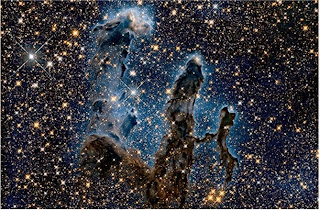 This image shows the pillars as seen in infrared light, allowing it to pierce through obscuring dust and gas and unveil a more unfamiliar view of the pillars.NASA, ESA/Hubble and the Hubble Heritage TeamRevisiting this star-forming region isn't only great for some mind-blowing photos, it also serves a practical purpose. As one would expect, the Pillars are highly dynamic and astronomers can compare the original observations with this modern version 20 years later. Any rapid motion in the clouds and changing brightness in stars can be detected and analyzed, potentially enriching theoretical star formation models.But for me, staring into the Pillars once more reminds me of my childhood fascination with the birth of stars within a nebula, the very definition of creation occurring only 6,500 light-years from Earth. This is where stars are born, eventually giving birth to systems of alien worlds and, in millions to billions of years time, possibly life.ENDMore at www.spacetoday.net